
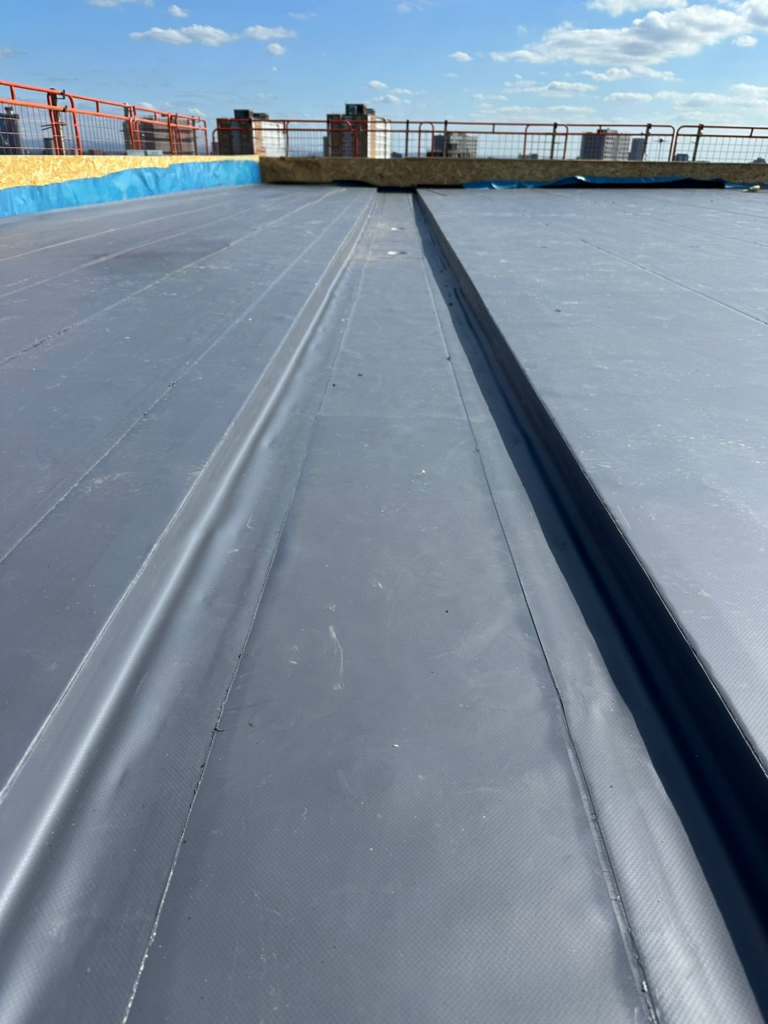
Flat roofs are a popular choice for commercial buildings, industrial units, and modern residential properties. However, there are a number of considerations to take into account for a flat roof, and one of the most important factors is the drainage. So how does drainage work on a flat roof?
Why is drainage important for a flat roof?
Unlike pitched roofs, where rainwater naturally runs down into gutters, flat roofs require a carefully designed drainage system to ensure water is removed efficiently. This is because when water cannot drain effectively from the roof for long periods of time, it can create what’s known as ponding water. This places additional weight on the roof structure and increases the risk of damage to the roofing membrane over time. This can lead to leaks, structural damage, and a reduced roof lifespan.
This is why a well-designed flat roof system, installed by a professional team, is essential. Effective flat roof drainage systems help to prevent these problems by directing water away from the roof as quickly as possible.
So, how does drainage work on a flat roof?
Despite the name, flat roofs are not actually completely flat. In fact, they are designed with a slight fall or slope that allows rainwater to drain away effectively. This is known as a “fall” or “gradient”, and involves using designated drainage points to direct the water too. These drainage points then carry water safely away from the building. There are several different drainage methods commonly used on flat roofs, including:
Internal drainage systems
Internal drainage is one of the most popular options for larger commercial and industrial buildings. With this system, drainage outlets are installed at low points on the roof surface. Rainwater flows into these outlets and is then carried through internal pipework within the building before being discharged into the drainage system below ground.
External gutters and downpipes
For many flat roofs, external gutters and downpipes provide an effective drainage solution.
The roof is designed to direct water towards the edge of the building, where it enters a gutter system. The water then travels through downpipes and into surface water drains.
Scuppers
Scuppers are openings installed in the parapet walls of a flat roof.
These openings allow rainwater to flow directly off the roof and into external downpipes or collection systems. Scuppers are particularly useful for roofs with parapet walls where traditional guttering may not be suitable.
They can also provide an additional level of protection by acting as overflow outlets if the primary drainage system becomes blocked.
What helps water flow across a flat roof?
As you can see, effective drainage for a flat roof relies on a number of factors working together. These include:
- Roof falls: A flat roof is usually constructed with a slight slope, often around 1:40 to 1:80, depending on the design. This subtle gradient may not be visible from the ground, but it plays a crucial role in directing water towards drainage points. Without adequate falls, water can collect in low spots and create ongoing drainage problems.
- Tapered insulation systems: Modern warm roof systems often make use of tapered insulation boards. These insulation boards are manufactured with varying thicknesses to create the required falls across the roof surface. This not only improves drainage but also helps maintain the thermal efficiency of the building.
- Drainage outlets: The location and number of drainage outlets are carefully calculated during the design stage. Properly positioned outlets ensure that water can leave the roof quickly and efficiently, even during periods of heavy rainfall.
What problems can affect flat roof drainage?
Even a well-designed drainage system can experience issues if it is not properly maintained. Some of the most common drainage problems include:
- Blocked gutters or outlets caused by leaves and debris
- Damaged or cracked drainage components
- Poor roof design resulting in inadequate falls
- Ponding water caused by settlement or structural movement
- Overflowing gutters during periods of heavy rainfall
Regular roof inspections can help identify these issues before they lead to more significant damage.
Conclusion
Drainage is an essential consideration for any flat roofing system. By using carefully designed falls, drainage outlets, gutters, and pipework, rainwater can be directed safely away from the building and prevented from causing damage.
For professional flat roof installation with drainage you can trust, we are the team for you here at Enviroply Roofing. Why not get in touch today to find out more?